Frozen Pipes in Atlanta: Thaw Safely, Prevent the Burst
Act before it bursts
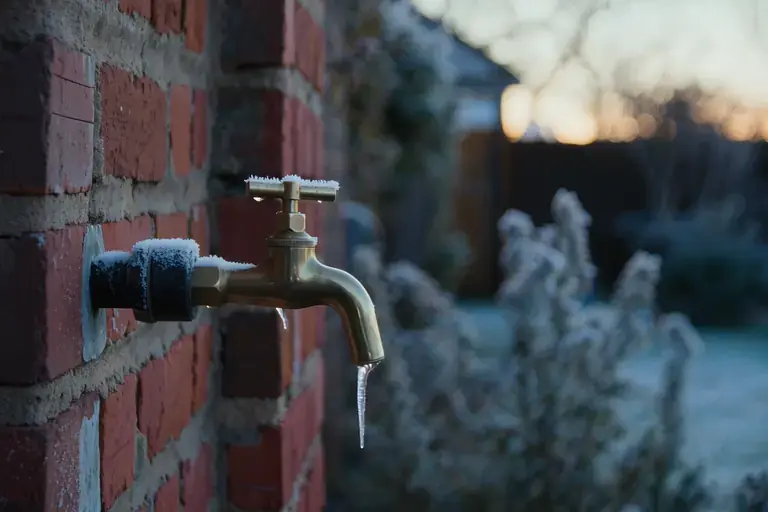
Do this now
- Suspect a freeze when a faucet gives only a trickle in hard cold. The likely spots are pipes against exterior walls and where the water service enters through the foundation.
- Keep that faucet open. Flowing water helps melt ice in the pipe as the frozen section starts to thaw.
- Warm the frozen section with a heating pad wrapped on the pipe, a hair dryer, a space heater kept away from anything flammable, or hot towels. Keep at it until full pressure returns.
- Never thaw with a blowtorch, kerosene or propane heater, charcoal stove or any open flame.
- Mind electricity around wet pipes: GFCI outlets and cords in good condition only.
- Check every other faucet in the house. One frozen pipe often means more.
- If it bursts before you win: main valve off, faucets open, and the burst pipe page takes over.
Can you fix it yourself?
Thawing an accessible pipe with gentle heat is homeowner work. The Red Cross draws the line clearly: if you can't locate the frozen section, can't reach it, or can't thaw it, call a licensed plumber. Pipes inside walls and ceilings are on the pro side of that line, and so is anything that already split, because a frozen plug can be the only thing holding the water back.
When to call a pro
- The frozen section is inside a wall, ceiling or slab
- You've applied heat and pressure isn't coming back
- Any sign of a split: bulge, frost line on the pipe, or water once it thaws
- You want pipes rerouted or insulated properly after a close call
We're a referral directory, not a contractor; this button opens our request form.
What to ask the plumber
- Can you get here before the next hard night, and what's the after-hours fee?
- If it already burst, will you pressure-test the rest of the system after the repair?
- Which of my pipe runs are most exposed, and what would insulating or rerouting them cost?
- Are you licensed in Georgia?
Questions we hear
At what temperature should Atlanta homeowners worry?
Georgia EPD's homeowner guidance says to be alert when outdoor temperatures threaten to drop into the 20 to 30 degree range, precisely because Georgia homes see sub-freezing nights only a handful of times a season and are built accordingly. By NOAA's 1991 to 2020 normals, Atlanta's airport still averages about 36 nights a year at or below freezing, and the first freeze typically lands in November.
Has it really gotten bad here?
December 2022 is the recent benchmark: Atlanta hit 8 degrees on December 24 and stayed below freezing all day. Clayton County's water authority reported frozen pipes and main breaks causing outages, 2,516 calls to its call center in days, and crews finding empty buildings with water pouring from internal breaks. Parts of DeKalb went under a boil water advisory covering nine main breaks that same week.
What actually prevents it?
The Red Cross list: let cold water drip from faucets served by exposed pipes during hard cold, open cabinet doors under sinks, keep the thermostat steady day and night, and never set it below 55 if you leave town. Outside, disconnect hoses. The North Georgia water district adds: a slow drip, not a stream. And know your main shutoff before you need it.
Sources
Every number and local fact above comes from one of these, read 2026/10. Spot something out of date? Tell us.
- American Red Cross: Preventing and Thawing Frozen Pipes
- Georgia Environmental Protection Division: Guidance to Homeowners for Preventing and Dealing With Frozen Water Pipes (rev. Feb. 2014)
- Metropolitan North Georgia Water Planning District: Freeze Ahead: Protect Your Pipes Now
- NOAA NCEI: U.S. Climate Normals 1991-2020: Atlanta Hartsfield Intl Airport
- National Weather Service Atlanta: Earliest, Latest and Average First Freeze Dates
- National Weather Service Atlanta: December 2022 Climate Summary
- Clayton County Water Authority: Officials Seeing Slow Improvements in Tank Levels and System Pressures (Dec. 28, 2022)
- DeKalb County: Boil Water Advisory Remains in Effect for Parts of DeKalb (Dec. 27, 2022)
- Insurance Institute for Business and Home Safety: Winter Weather Ready guide
- University of Georgia CAES Newswire: Keep exposed pipes and hoses protected